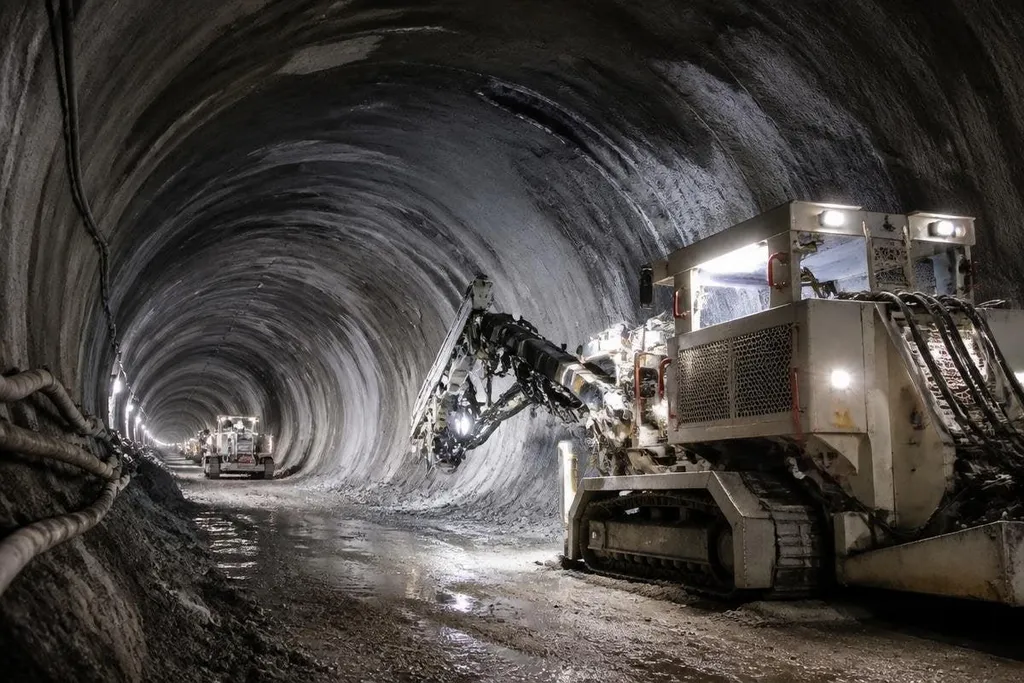
Tunnel robots can cut rock, place lining, remove spoil, or inspect the finished passage. The hard part is making those tasks work together underground, where dust, water, poor visibility, and changing ground conditions leave little room for manual fixes.
- Cutting and lining must work as one process
- Remote control still matters when autonomy fails
- Cost per metre will decide whether projects use robots
The work is more than digging
Tunnel boring machines already combine several jobs in one moving system. A robotic approach has to deal with the cutting head, ground support, spoil removal, surveying, power, and maintenance as one worksite rather than a set of separate machines.
That connection matters because a delay in one task can stop the rest. A cutter may be ready, but lining work may need to catch up. A haulage system may be available, but a blocked route can leave broken rock in the way. The robot must keep a clear picture of its position, the tunnel shape, and the work completed behind it.
Sensors can help measure those conditions. Cameras and LiDAR can map surfaces, while force sensors can show when a drill, gripper, or support arm meets more resistance than expected. Underground, sensor readings will degrade as dust covers lenses and water changes the view. The system needs a plan for those failures.
Autonomy will come in small steps
Full autonomy is a poor starting point for a tunnel. A safer design would give software control over repeatable actions, then leave unusual ground, equipment faults, and safety decisions to a remote operator.
That split could change as the system gathers site data. The robot might first follow surveyed paths, then adjust its route when the tunnel profile changes. It might also flag a loose section of rock for human review instead of acting on a doubtful reading.
The operator still needs clear feedback. A control room should show the robot’s location, tool condition, power state, sensor quality, and reason for each stop. A system that cannot explain why it paused will create a new delay for the crew.
Tunnel automation has to earn its place in the project budget, where machine cost, crew size, downtime, and repair work decide whether a plan survives beyond a test site. Robotics project cost reporting can put those figures beside a named machine and work setting before the next section weighs the design.
The economics will decide the design
A tunnel robot does not need to remove every worker to earn a place on a project. It may be useful if it keeps people away from unstable ground, cuts inspection time, or lets a crew work in areas that are difficult to reach safely.
The measure should be cost per finished metre, not the number of robotic features. That figure includes machine purchase or rental, power, maintenance, software support, operator training, downtime, and the cost of recovering a disabled system.
A machine that works well in a clean test area may still fail the business case if repairs require a specialist team to travel underground. Spare parts, access routes, backup control, and manual recovery tools belong in the first design review, not after the pilot starts.
I’d back systems that automate one repeatable tunnel task well before systems that claim to run the whole site.
What remains unproven
Site evidence still needs to answer how the system handles changes in rock strength, water, and tunnel shape. Buyers also need to know how it detects a damaged cutter, drill, arm, or lining tool before work quality falls.
Communication loss raises another question: what does the robot do when the link to the control room drops? A crew must also be able to reach, isolate, and move the machine after a serious fault, while safety tests must show which tasks can run without a person nearby.
These are practical tests, not software features on a product sheet. A future system may pass some of them and still need people for the rest.
A buyer’s checklist
Before backing a tunnel robotics project, check five points:
- Define the task in metres, hours, or inspections completed.
- Set a manual fallback for every automated action.
- Ask how dust, water, weak signals, and tool wear affect sensing.
- Price recovery work, spare parts, training, and remote support.
- Run the pilot on the ground conditions the final project will face.
The next useful proof will come from a tunnel where the robot works through changing ground, routine maintenance, and a fault without turning the crew into a rescue team. Until that evidence arrives, the soundest target is modest: automate a measured task, record the metres completed, and expand only when the numbers hold.